What Are Peak Sun Hours?
What are Peak Sun Hours?
Solar panels work by turning sunlight into electricity. How much sunlight your roof gets can impact how much electricity your home solar panels generate.
We have a way to measure how much sunlight a location gets: peak sun hours. You can go solar and save without understanding this one element of the solar equation, but knowing what peak sun hours are can be useful to understand how much electricity your solar panels generate.
What’s the definition of peak sun hours?
A peak sun hour is a measure of the intensity of the sun’s rays over time: 1,000 watts per square meter for an hour. If a location gets 1,000 watts of sunlight over an hour, that’s a peak sun hour. If that same location gets 500 watts of sunlight over two hours, that’s also a peak sun hour. If a location gets five peak sun hours a day, it means the total power it receives from the sun is equivalent to five hours of sunlight at a power of 1,000 watts.
The amount and intensity of sunlight is also termed solar insolation or solar radiation. In the lower 48 of the US, average peak sun hours range from 3.5 a day in western Washington and Oregon up to 6 a day in Las Vegas, southern inland California, and western Arizona. Most of the continental US gets 4.2-5.5 peak sun hours a day.
Peak sun hours are not the same as total daylight hours or all the time from sunrise to sunset or the hours in a day the sun's strength reaches a certain threshold.
In scientific terms:
1 peak sun hour = 1,000 W/m² (or 1 kW/m²) of sunlight over an hour.
In other words, if your location receives 6 kWh/m² of solar radiation in a day (for example, 6 kWh/m² from 8:30 am to 6:30 pm), you would get 6 peak sun hours.
What should I understand about peak sun hours?
The average homeowner going solar doesn’t need to have a deep understanding of peak sun hours to go solar. Since your chosen solar installer will design your system, you won’t be on the hook for the finer details.
And, once your solar panels are up and running, you'll be able to track production in the Palmetto app, where you can also learn about how to reduce your energy consumption and, when you do, earn discounts on energy-saving devices.
If you want to get into the finer details, knowing your region’s peak sun hours can help you determine the ideal size of the solar panel system for your home.
What are peak sun hours by state?
Each state has a unique number of average peak sun hours due to the variation in the different climate zones.
The table below shows the peak sun hours by state across the country averaged over the year.
| State | Peak Sun Hours | State | Peak Sun Hours | State | Peak Sun Hours |
|---|---|---|---|---|---|
| Alabama | 4.5-5 | Louisiana | 4.75-5.25 | Ohio | less than 4-4.25 |
| Alaska | less than 4-4.25 | Maine | less than 4-4.25 | Oklahoma | 4.5-5.5 |
| Arizona | 5.25-more than 5.75 | Maryland | less than 4-4.5 | Oregon | less than 4-5 |
| Arkansas | 4.5-5 | Massachusetts | less than 4-4.25 | Pennsylvania | less than 4-4.25 |
| California | 4-more than 5.75 | Michigan | less than 4-4.25 | Rhode Island | 4-4.25 |
| Colorado | 4-5.5 | Minnesota | less than 4-4.25 | South Carolina | 4.5-5 |
| Connecticut | 4-4.25 | Mississippi | 4.5-5.25 | South Dakota | less than 4-4.75 |
| Delaware | 4-4.5 | Missouri | 4-4.75 | Tennessee | 4.25-4.75 |
| Florida | 4.75-5.5 | Montana | 4-4.5 | Texas | 4.5-more than 5.75 |
| Georgia | 4.25-5.25 | Nebraska | 4-5 | Utah | 4-5.75 |
| Hawaii | 4-more than 5.75 | Nevada | 4.25-more than 5.75 | Vermont | less than 4 |
| Idaho | less than 4-4.5 | New Hampshire | 4-4.25 | Virginia | 4-4.75 |
| Illinois | 4-4.5 | New Jersey | 4-4.5 | Washington | less than 4-4.5 |
| Indiana | 4-4.5 | New Mexico | 5-more than 5.75 | West Virginia | less than 4-4.5 |
| Iowa | 4-4.5 | New York | 4-4.25 | Wisconsin | less than 4-4.25 |
| Kansas | 4.25-5.25 | North Carolina | 4.25-5 | Wyoming | less than 4-5 |
| Kentucky | 4-4.75 | North Dakota | less than 4-4.25 |
Source: NREL
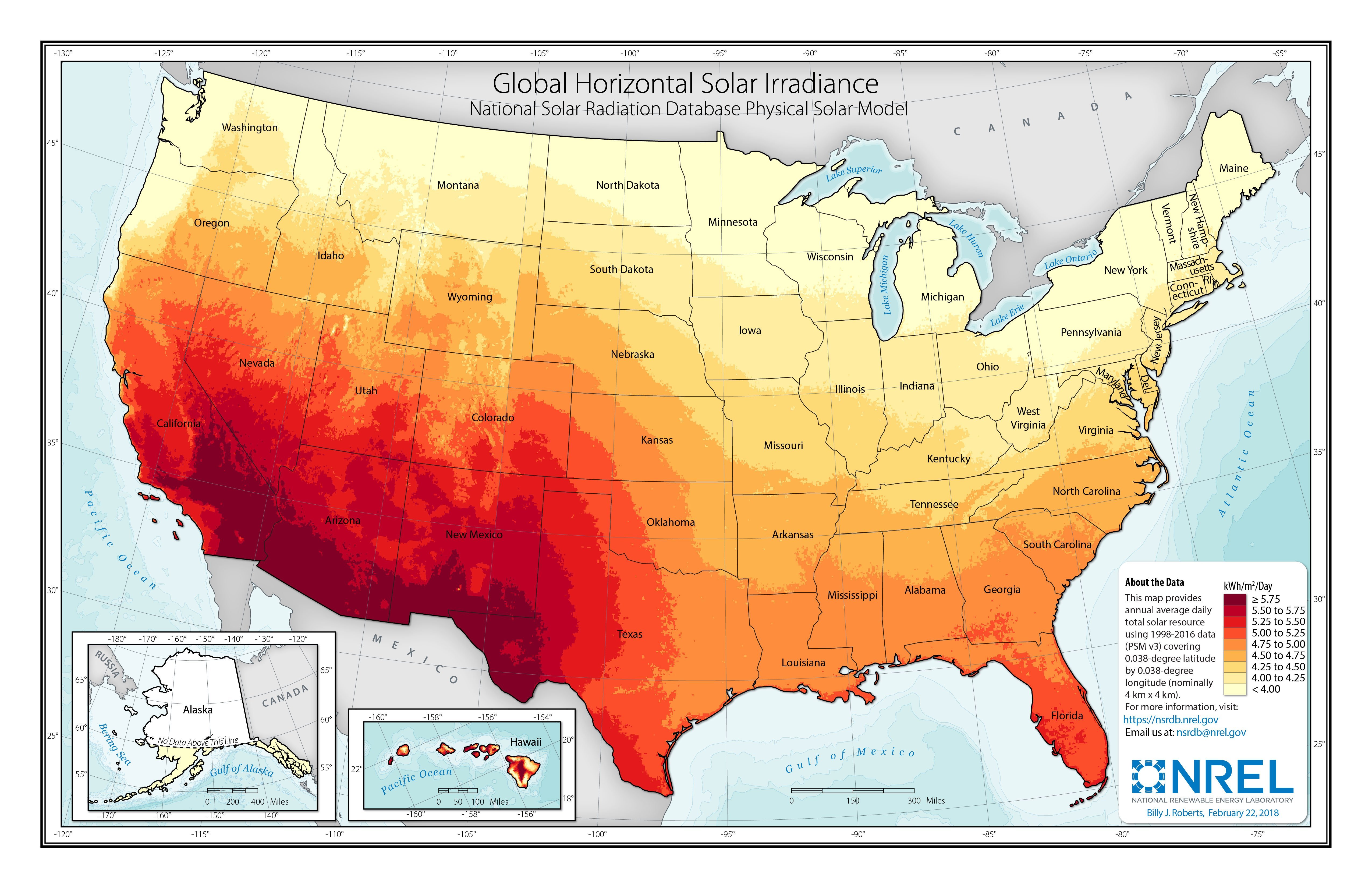
Solar companies use this factual information about the average daily peak sun hours your area gets to help you make better decisions about the right solar panel system for your home in terms of the energy you need.
Why do peak sun hours vary by location?
Peak sun hours vary by latitude and seasonality. Very generally speaking, the closer to the equator, the more peak sun hours your area gets. The sun hits the Earth at a more direct angle for longer periods of time the closer you get to the equator.
Then solar radiation changes by season. The average peak sun hour number falls to 25-50% below the yearly average in winter and is 25-50% above the average in summer.
Climate also plays a role. The more sunny days you have, the higher your peak sun hours.
How will peak sun hours impact my solar panels?
Knowing your region's average peak sun hours can be a useful gauge of your home’s solar potential. Using the example below, let's see how you can use peak sun hours to calculate how much electricity you need your solar panel system to create:
- Peak sun hours = 5.75
- Your home used 25,000 kWh of electricity last year
- 25,000 kWh / 365 days = 68.49 kWh per day
- 68.49 kWh per day / 5.75 peak sun hours per day = 11.9 kWh
- You should install a 12 kW solar PV system
Your solar panels need the direct sunlight of peak sun hours to generate the maximum electricity possible for your home. However, you don’t need to move to a state with the highest number of peak sun hours to enjoy the perks of solar power. It just means a home in Massachusetts using 25,000 kWh a year will need more solar panels in their rooftop array to generate that much electricity than a home in Arizona with the same amount of annual usage.
Other factors besides average daily peak sun hours impact your solar panel system energy production capacity, including:
- Home consumption: Home energy consumption remains the biggest factor in determining the size of a solar panel system.
- Solar panel efficiency: A solar panel can be roughly 20% efficient, with high-efficiency solar panels nearing 25% efficiency.
- Storage capacity: To meet your energy usage needs, you can add battery storage to your solar panel system.
- Future growth: You may decide to install more panels on your roof than you currently need if you anticipate your energy needs will increase in the future.
Ways to take advantage of peak sun hours in your home
Now that you know what peak sunlight hours are and why they should matter to you, let's learn how to get the most out of them.
- Store more electricity. Your solar panels will reach their maximum effectiveness when the sun's intensity is highest. They will likely produce excess electricity at this time. Installing a solar battery system can ensure you can capture all the energy you generated.
- Leverage net metering. If your solar panels are creating more electricity than you’re using, you can benefit from net metering.
Talk to Palmetto today or get your free solar savings estimate to learn more about how your home is a fit for solar panels. Our experts can assist with your solar panel decisions by taking into account different factors, including your preferences and budget.